Showing posts with label Kurt Cobain. Show all posts

Monday, February 8, 2016

Nirvana - Bleach


When I was fourteen years old, it seemed like everything was Nirvana, and Nirvana was everything. With the Lights Out had just hit shelves, catalyzing a furious interest in the band’s back catalog that ran rampant through my friend group in high school. Burned copies of Nevermind and In Utero were passed around like a juicy piece of gossip; however, it wasn’t until I browsed the local FYE that I ran into a copy of their debut, Bleach, an album I just could not understand as a child. But having recently felt its pull again, I dove right in, this time arriving at a new appreciation for Nirvana’s gritty and groaning first-impression. 

Lots of my favorite records tear into a run right off the gate, but it’s been a long time since I’ve heard anything erupt quite like Bleach does. This record has almost more energy than it knows what to do with: Krist Novoselic’s bass roars behind a guitar drenched in feedback and overdrive, Chad Channing’s bass drum beats like a blacksmith’s hammer, and Kurt Cobain yelps and growls with such force that his throat sounds like it’s about to collapse. The band rages through slow and fast tunes alike, imbuing the grinding beats of “Sifting” and “Paper Cuts” with the same visceral passion as those in “Negative Creep” or “Downer.” Kurt’s rampant guitar tones conjure up spirits similar to Black Sabbath, yet the band rocks with a ferocity oft reserved for hardcore punk acts like Minor Threat. Nirvana manages to give every ounce of strength and feeling they have to their music, forcing each song through the speakers like a shotgun blast.


 Though the priority of this record’s sound is certainly energy, it is not all noise and ire; the beginnings of the pop sensibility Kurt Cobain would be worshipped for are apparent even on their debut. Though in a few short years Nirvana would be considered the kings of grunge, when the band was writing Bleach, they were dealing with an apparent pressure to conform to the Seattle sound that surrounded them. The scene wanted heavy guitars and screeching vocals, and while Kurt did his best to oblige, he could not keep his softer influences entirely absent; “Swap Meet” and “School” both revolve around catchy vocal melodies, and “About a Girl” wholly embraces a pop angle, forgoing dissonance or insanity for gentle vocals and tailored key changes.

Even before the world was waiting for him to write “Smells Like Teen Spirit” over and over, Kurt Cobain had a knack for blending the heavy and the melodic, and “School” is an excellent example of this synthesis. Operating wholly on a “less-is-more” ethic, the four chords and fifteen words that make up “School” manage to create a piece both riveting and rocking. Chad Channing’s voracious drumming guides the tune through dynamic changes, while Kurt’s guitar and vocals battle for the spotlight, remaining brutal in the style of Bleach, yet catching the ear more than enough to cause a craving. “School” is a prototype of the formula that would soon drive Nirvana to success, a song incubating the emotions and attitudes that Kurt would explore more heavily in later records.


Besides forming a pop blueprint, “School” is indicative of the Bleach sound in other ways, specifically the sparse and general lyrics that blanket the record. As Kurt admitted in interviews, “With Bleach, I didn’t give a flying fuck what the lyrics were about. Eighty percent were written the night before recording.” This lackadaisical approach to writing leaves a lot to be desired from the lyrics, especially direction. “Big Cheese” and “School” can be taken to address the band’s experience with corporate influence, but random lines like “She is glue, how are you?” force the song to veer off into nonsensical territory. Similarly, “Scoff” almost sounds like a mission statement, but how Kurt’s demand of “gimme back my alcohol” adds weight to that statement is unclear. Indeed, other than a penchant for fun little rhymes, “Sifting” fails to communicate anything at all. 

Although lyrical content might have been “the least important subject” to Cobain, he does manage on occasion to say something of value on Bleach, specifically on the theme of rural communities. The nightmarish “Floyd the Barber” bastardizes America’s favorite small-town, but in doing so, Cobain comments on the massive disparity that exists between TV’s Mayberry and the reality of working-class life. Similarly, “Swap Meet” caricatures two characters scraping out a brittle living by selling items at the flea market, and from the bitter way they apparently avoid each other, their existence is far from happy. Songs like these show Cobain as completely capable with a pen in his hand, if only he chooses to apply it.


The lyrics might be wanting for some love, but overall, Bleach is as loud, gritty, and honest as a debut record ought to be. As Kurt puts it, Nirvana’s purpose was simply “to have fun, write songs,and play.” There is passion without pretension on this record, and for Nirvana, that passion “comes before anything else.” Bleach shows a band just working to get their footing, pressing their hearts onto vinyl and launching it into an uncertain future. Over ten years since I first bought my copy, I can finally hear that truth, and it is indeed a sweet sound. 

Tunes to Check Out:
1) School


Sunday, November 8, 2015

Teenage Fanclub - Bandwagonesque


            About a year after Kurt Cobain’s Journals had been released, I found a copy of the controversial book on the shelves of my local library, and couldn’t resist flipping through the glossy pages. Inside one of the many short lists of favorite records Kurt had been creating, he had penned a reference to Teenage Fanclub’s Bandwagonesque,[1] and the name rang strangely familiar in my head. I hurried to the library’s CD selection, where lo-and-behold, I found a broken-cased copy of Bandwagonesque, which I had already noticed and ignored numerous times when I had browsed the library’s selection. 


            Convinced I had stumbled upon some lost treasure, I rented the aged disc and brought it home to spin in my weathered walkman. Knowing that Kurt Cobain himself held this record in high regard,[2] I convinced myself it must be some secret treasure of alternative music, and I eagerly popped my headphones on. Initially I was underwhelmed, but since those days, Bandwagonesque has been a record to which I repeatedly return, for its simple, sallow melodies manage to capture my attention in new ways every time.
            Upon first (or really, even tenth) listen, it is not easy to see how the minimalistic music that defines Bandwagonesque found a way to resonate with listeners so powerfully that they would name it “Album of the Year” in 1991 (over Nevermind!).[3] While the instrumentation is certainly fun, there is hardly anything to it: guitarists Norman Blake and Raymond McGinley rely steadfastly on open chord shapes or simple solos throughout, while Brendan O’Hare chugs like a tugboat through smooth but repetitive drum beats. Only bassist Gerard Love seems to do any exploring of his instrument, his moving basslines wandering comfortably beneath the shoegazy wash of guitar and even threatening to drive some of the songs into melodic territory. But while the performances hardly rise above “slacker” on the enthusiasm scale, Teenage Fanclub manages drain every ounce of catchiness from their simple approach, creating a record that is liable to be stuck in your head for weeks after you spin it.
            Their four-chord song structures and droopy tempos may avoid pushing a single sonic boundary, but the members of Teenage Fanclub are no simpletons. Instead of toying with time signature or key changes, the entirety of Bandwagonesque instead serves to completely deconstruct the idea of anticipation. Almost every song finds a way to fuck with the listener’s expectations: “Satan” is a minute of noise followed by twenty seconds of composition, and “Star Sign” features over a minute of ambient, aimless guitar washes before abruptly beginning the tune proper. 


            Song endings are also regularly deconstructed. Both “I Don’t Know” and “December” trick the listener into a resolution that isn’t ready to quit yet, continuing on after multiple false endings, while other tunes seem to go on forever. “Pet Rock” offers thirty seconds of lyrics before an extended jam over a single chord, broken up only by a solitary, impotent horn piercing the background, and “Metal Baby” follows a similar vein. As McGinley once stated in a Spin interview, the band believes that “once you start trying to fulfill other people’s expectations of you, it’s gonna die.”[4] Teenage Fanclub unabashedly toys with even their listener’s needs on this record, pushing the limits of sonic tension and release far past the norm.
            While virtually every tune on Bandwagonesque messes with the listener’s anticipation, perhaps the best example is the iconic opener, “The Concept.” Opening with Norman Blake’s moaning guitar and vocals, this song trudges along at a slow pace, soulfully winding a vague tale of a girl who spends time with the band. Blake leads the band through a fully structured song, regaling three verses and a quick, furtive guitar solo before trailing off from a final chorus. Logically, the song should end there, but instead, O’Hare’s crawling drum fill leads the listener into an extended outro that is longer than the song proper. The band proceeds to sing a wordless harmony over the slowest tempo known to man, interspersing guitar leads that would put even the most celebrated 80’s ballad to shame. “The Concept” epitomizes Teenage Fanclub’s meddling with the idea of tension on this record, yet presents it with pop sensibility and sweet melody that both satisfies and delivers.


            Much like the instrumentation, the lyrics that Teenage Fanclub presents on Bandwagonesque are rooted in simplicity; however, the lack of flair in the words unfortunately serves to do more damage than good for this record. In an interview with The Bob, drummer Brendan O’Hare admits that the writing process for the band arose mostly “just from mucking about,”[5] while Norman Blake has admitted in retrospect that the members of the band “weren’t taking anything too seriously at that point” in time, writing almost all of the lyrics in the studio.[6] And while there is certainly nothing wrong with a band throwing a song together, the sheer lack of enthusiasm or even coherency in the record’s lyrics leave a lot to be desired.
            A prime example lies in “What You Do to Me,” comprised only of four lines that are so vague and noncommittal, they describe absolutely nothing: “What you do to me / I know, I can’t believe / There’s something about you / Got me down on my knees.”[7] And though some songs like “Sidewinder” and “Guiding Star” focus their energy enough to create a scene or feeling, they feature a distinct lack of innovation, recycling worn-out clichés like “I love your walk….I love your talk”[8] and “you’re my number one.”[9] While every tune on Bandwagonesque is driven by a gentle hook and unassuming melody that catches the ear, the lyrics largely serve neither to add context or steer the song in any way, forcing the listener to rely on the instrumental tracks like “Is This Music?” for depth and emotional expression.


            If you can forget about the lyrics (a pretty easy task, considering their complete lack of substance), Bandwagonesque remains a remarkable listening experience, but one song does manage to piece together a lyrical idea that is not only coherent, but actually interesting. The Norman Blake composition “Alchoholiday”[10] paints a powerful scene of a relationship that is very quickly losing its meaning. With lines like “Ever get a feeling when you’re taken by the hand / And led a course you can’t command,” Blake subtly relates a lack of control, hinting at terror and yet whizzing by it without leaving time to digest what is actually happening. He then furthers his scene with an air of dissatisfaction with the lines “Fall into line but I’m doing nothing / We’ve got nothing worth discussing” before slipping into the decisively hurtful chorus of “There are things I want to do, but I don’t know if they will be with you.”[11]  Although far from mind-blowing, “Alcoholiday” manages to hold together a vivid and relatable lyrical theme, an accomplishment that no other song on the record manages to approach.


            Though very little of this record holds up under severe scrutiny, I must say that I am still enamored of its simplistic charm. For all that Bandwagonesque lacks in grace and intricacy, it more than makes up for it with infectious pop hooks and a lackadaisical charisma. Bandwagonesque comes unadorned, exactly as it is, and thus I can see how Kurt Cobain was enamored of it, even after it beat out his own band. It’s a fun, confusing-yet-pleasant listen from front to back, and I still get a tickle in my soul whenever it wanders its way back into my life. 

Tunes to Check Out:
1) Alcoholiday
2) I Don't Know
3) Star Sign 


[1] Cobain, Kurt. Journals. New York: Riverhead, 2003. 233. Print.

Saturday, January 11, 2014

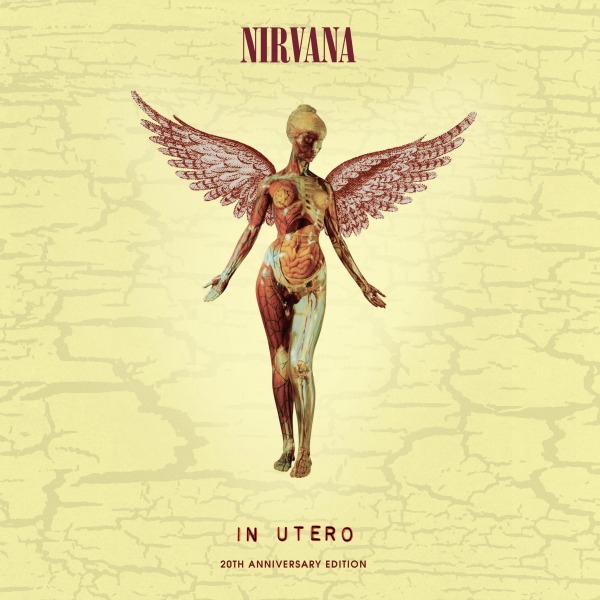
Nirvana - In Utero


Quite a few artists in the genre of rock get pinned with the adjective “seminal,” yet few are so universally recognized as Nirvana. It wasn’t until about the age of twelve that I really found out who Nirvana was, and everyone I encountered simply could not believe I had yet to delve into their music. Thus, like many of my generation, I became engrossed in Nirvana’s catalogue during their resurgence in popularity following release of the With the Lights Out box set and Kurt Cobain’s Journals. I got my grubby teenaged hands on every release within my reach and immersed myself in the mountain of music and literature surrounding this mythic group.
During this time, I remember being caught up in the hype around this legendary act, sucking down biographies and recordings with fervor. Most of my time was spent with their studio albums (being both readily available and wholly celebrated), yet the one that received the least attention was In Utero, Nirvana’s final true studio release. Though I had spun it dozens of times, I found the abrasive, feedback laden, brutally raw tracks to be frightening and headache-inducing, and thus clung to the radio singles and abandoned the rest. Perhaps my age stood in the way, for I could not know that in returning to that same record ten years later, I would be addicted to those bleeding deep cuts that once drove me back.
Though as a young boy I read and re-read the saga of Nirvana’s rise and collapse, the artistic struggle to remain both creative and credible was something I couldn’t truly fathom. Unfortunately for fourteen-year-old me, unwavering commitment to that ideal is an integral factor in the sound of In Utero. For their third full length, Nirvana recruited producer and indie legend Steve Albini[1] in hopes that he could assist them in creating a record devoid of the label influence and over-production that had so overwhelmed Nevermind. Being that Albini had produced The Pixies’ Surfer Rosa,[2] a band idol, they knew what they were getting into, and the result is as chaotic, messy, and real as anyone could have hoped for. Kurt’s guitar screams through his distortion pedal for most of the record, releasing melodic solos and grating chords amidst horrifying squeals of feedback. Krist Novoselic’s bass growls like a tank, and Dave Grohl’s drums hold more punch than a battery of cannons.
In Utero invades the ears like an army of mastodons at first listen, but repeated spinning shows that this record is much more than noise. Although Albini certainly helped the band achieve the aggressive tone they’d been seeking, all of the pop-driven songwriting which made Nirvana into a household name is still completely captured in and complemented by this musical hurricane. Before the release of the album, Cobain remarked that In Utero was not an attempt at abandoning Nevermind or its fans: “Let’s face it, we already sold out two and a half years ago. There’s no sense in trying to redeem yourself by putting out an abrasive album and pretending you’re a punk rocker again.”[3] Thus, tunes like “Heart-Shaped Box” and “All Apologies,” featuring clean guitar and soft singing from Cobain, lay adjacent to punk monstrosities like “tourette’s” and “Very Ape,” yet neither style really overshadows the other. Indeed, the vulnerability that this band displays in some of its lighter tunes offers just as much definition to In Utero as the thrash and bash sound of the mix. The fact that Nirvana, while trying to make a record that is untainted by corporate greed, still insists on imbuing their music with meaning and melody shows that, even with ideals and anti-ideals in mind, this band’s first mission remains making the music it wants to make.
One tune that captures Nirvana’s well-worn and pop-driven side is “Dumb,” perhaps the tamest tune off of In Utero. Described as “Beatlesesque,”[4] this track twists the provisional template of the production into a melodic masterpiece that remains in rotation for many radio stations. Against the more belligerent songs, “Dumb” stands out not only for its focus on gentility and beauty, but also its uncharacteristically optimistic lyrical content. Although the speaker appears unsure on his feet, he asserts, “I’m having fun”[5] despite any obstacles that might land in front of him, whether they be darkness or over-intoxication. The positive and calm energy of this tune contrasts starkly with the punk fury around it, but it lacks for none of Nirvana’s emotionally-laden energy, and remains one of my favorite Nirvana songs of all time.


Due to its immediate catchiness and mellow approach, “Dumb” is a bit of a black sheep on In Utero. The majority of the music on the record is both messy and violent, and Kurt’s lyrical and vocal contributions are just as chaotic. He spends half of the record guiding his vulnerable voice through skittish moaning melodies, and the other forcing that voice into guttural, almost primitive screams—his yells leading into the chorus of “Scentless Apprentice” are so loud that the vocal track clips. While certainly entertaining, many of his lyrics sink underneath his delivery, making them all but unintelligible. As for the lyrics themselves, Kurt wavers between pop sensibility and punk rock rebellion, offsetting his clichéd hooks with a plethora of sickness and death imagery. His melodies provide the listener with unstoppable choruses that get lodged in the head, but when built on refrains like “Sit and drink pennyroyal tea / distill the life that’s inside of me” or the simply blatant “Rape me,” those melodies wriggle like tapeworms swimming through the intestines.
While every song seems to have a general theme or direction, the sparse wordwork and mild metaphor aren’t too conducive to the movement of ideas; however, the songs work very well to convey universal themes on the record, specifically the band’s reaction to the debacle of fame they experienced two years earlier. After releasing a monster record like Nevermind, the bar for a follow-up certainly must be ludicrous in its height, and the buzz surrounding that venture is enough to drive most into madness, but Nirvana’s choice to deal with said fame in the sarcastic composition of their new record is brilliant. Kurt directly addresses the focus of the public on his life in “Serve the Servants” with the line “That legendary divorce is such a bore,” and plays on their success with an opening of “Teenaged angst has paid off well / Now I’m bored and old.”[6] In “Frances Farmer Will Have Her Revenge on Seattle,” he laments the loss of the innocent simplicity of being in a band, groaning his chorus line “I miss the comfort in being sad.”[7] The music itself also reacts to Nirvana’s stardom, as the band continually denies the listener resolving notes at the end of their songs, letting them peter out into feedback and moans rather than achieving a climactic close. The band eschews conventions in popular music, playing on dissonant intervals and unfiltered candor in their boredom with being idols, effectively giving the music industry and anyone else who believes “Nirvana = Nevermind” a big middle finger.


For a record laden with derision and indifference, no track offers more sarcasm than “Milk It.” This grueling and boisterous tune features Nirvana purposefully avoiding almost anything that a “Top-40” lover needs to enjoy music. The song begins with Kurt randomly picking his guitar through gross intervals that feel intentionally wrong, before sidling into an overdriven riff. Dave Grohl’s drumming deliberately misplaces the downbeat, making it impossible to tap your foot along with the tune. Kurt moans in the verses and almost vomits in the chorus, keeping his vocal sounds far from pronounceable. This musical dumpster is capped with lyrics laden with sickening imagery, as he hangs on the motif of parasites feeding off of the least appetizing of human bodily fluids. The song seems a sardonic comment on fame, an acknowledgement that an artist could sell absolute rubbish to its fans if they have enough backing, as well as many musicians’ willingness to “milk” stardom by putting no meaning or intention behind their art. While a commonly addressed issue in the music world, Nirvana uses “Milk It” to put themselves under the spotlight for this very issue, using a crass and sarcastic attitude to respond to assertions that they fall under the umbrella of “soulless sellouts.”


Anyone who takes the risk of spinning In Utero can expect an overdose of feedback and unbridled anger, but there is more than enough energy and melody to turn the noise into meaningful music. Nirvana’s last record is one that requires attention and thought, something a younger me couldn’t give, and that an older me is glad to apply. When examined in a thoughtful and receptive fashion, even the radio hits that have pummeled alternative radio for two decades become fresh and momentous. Thus, if you dare pick up In Utero, take the Nirvana you think you know out of the equation, and judge it for what it is—you may find something with which to fall in love.

Tunes to Check Out:
1) tourette's
2) Milk It
3) Serve the Servants