Saturday, February 23, 2013

Possum Dixon - (Self-Titled)


            On one of my many trips to the local music store, I found a large bin labeled “CDs – 2 for $1,” a bargain I could not pass up. Whilst trudging through the piles of compilation records and overprinted hit CDs, I ended up selecting 6 unfamiliar albums to take home with me, chosen on the merits of the band name alone. One of those choices, a self-titled LP by a band named Possum Dixon (a moniker whose origin ranges from an old car[1] to a wanted criminal[2]) has since become one of my favorite listens.
            With their eponymous debut LP, Possum Dixon offers a very unique sound. Each song has its own character, ranging from rock n’ roll riffs to thrashing punk beats, all presented in an exclusive and explosive style. This uniqueness is given a violent voice in the many moments of absolute chaos peppering the record, where Rob Zabrecky rakes his bass strings or Rob O’Sullivan smashes his keys to pieces. While such noise is normally considered abominable in the music world, Possum Dixon presents mischievous moments of art juxtaposed against the more tame and musician-approved structures of the songs. Such use of chaos and craziness serve to strengthen the impression of their tight musicianship as well as to give a taste of the mania of their live shows.

            A great example of chaos and composition coming together in harmony is the song “In Buildings.” The gentle intro of synth and drums belies the building urgency that Zabrecky relates through his voice. While the band holds a generally steady feel throughout the song, both the vocals and the keys begin to spiral out of control, as Rob O’Sullivan punctuates every beautiful note with a dissonant punch to the keyboard. The song crescendoes as Zabrecky pines for “fifteen minutes on a couch” with the girl who makes him shake. Tension builds until the song collapses finally into a dissonant bass chord, but the beauty and catchiness of the melody and groove are never overshadowed by the underlying bedlam.
            While “In Buildings” exemplifies the good side of insanity in music, at times, this chaotic feel, shooting for the title of “art,” falls far short into the massive valley of “noise.” “Nerves,” the opening track of the album, seems to collapse into an inferno as it nears its end, while “John Struck Lucy” is built on the faulty foundation of an audibly-displeasing piano line. However, the charisma of the songs that Possum Dixon presents is something that cannot be ignored. The lyrics of the album are simple yet graceful, and always tinged with absurdity. Zabrecky’s writing style is overtly sexual in many places, a theme that greatly connects with the urgent insistency of the music. But just as often, we are presented with pure poetry. In the song “John Struck Lucy,” the speaker takes a methodical and extremely understated approach to the subject of abusive relationships, while in “Elevators,” the speaker personifies this form of transportation as a woman.
            The construction of the music on the record is just as controlled, stressing catchy and danceable rhythms. The energetic and pleasing vocal melodies of tunes like “We’re All Happy” or “Watch the Girl Destroy Me” (which peaked at No. 9  on the Modern Rock Tracks Chart[3]) almost guarantee audience participation while complementing the distinct and rocking livelihood the band lays claim to. Zabrecky’s basslines range from gentle walks to pounding beats, all of course punctuated with absolute recklessness, while Celso Chavez’s guitar riffs reminisce of a multitude of styles, including ska and blues; but all the while, the band’s dynamic sound refuses to be lumped into any one genre, though critics and fans certainly might try.[4] The band’s compositions present equal parts beauty and insanity, making it apparent that even behind the madness there is a method at work in the music of Possum Dixon.


            Through their debut, Possum Dixon created a catalog of music that is wholly unique to them. They often deny us many of the common courtesies of a resolving note or a maintenance of rhythm, and barrage our ears with audio hissy fits on their instruments. Yet, their songs uphold such a level of honesty and exuberance that I cannot think of a better 50 cent purchase. One thing is for sure as this record spins: there is never any confusion as to who you are listening to.

Tunes to Check Out:
1) In Buildings
2) Watch the Girl Destroy Me
3) Elevators

Wednesday, February 20, 2013

At the Drive-In - El Gran Orgo


            Many bands have been considered influential in the growth of punk music, but few have had as remarkable of an impact as At the Drive-In. Known for their incredible and energetic live shows, At the Drive-In has come to be considered a seminal piece of punk and hardcore history. Generally, their later records, especially their last full-length, have taken the brunt of the attention, leaving their earlier work to dither in obscurity. However, one record by At the Drive-In that not only deserves attention, but indeed demands it, is their 1997 EP, El Gran Orgo.  
            The twenty minutes of music provided on this EP are explosive and exciting, overflowing with thrashing guitars, crunchy drums, and searing vocal melodies. While the band occasionally worried that their live energy was lost on their recordings, El Gran Orgo easily smashes those doubts with every listen. If anything, this EP provides an enticing preview of ATDI’s live show rather than a watery doppelganger. The record is bristling with youthful havoc and vigor, with all cylinders rapidly approaching critical heat levels. Omar Rodriguez-Lopez, whose first foray as a guitarist is laminated in El Gran Orgo, absolutely tears it up, while Tony Hajjar and Paul Hinojos, the band’s newest members, prove themselves to be a monster rhythm section.[1] The taut and experienced sound At the Drive-In provides on this EP belies the many lineup changes that the band experienced prior to this recording, including the hiatus of founding member Jim Ward.[2] Indeed, some consider it to be the birth of the sound that At the Drive-In soon became well known for.[3]
            While At the Drive-In puts its musical fervor forefront on El Gran Orgo, the band’s musical abilities are never overshadowed by their energy. Their array of songs offers a mix that is equal parts catchiness and dissonance, a balance that works well for the record. Furthermore, the varied sound provided by ATDI prevents them from being pinned in any one genre. “Give It a Name” and “Speechless” spearhead catchy choruses and pop melodies, while “Fahrenheit” and “Picket Fence Cartel” offer themselves up as post-hardcore pieces. This EP is dynamic in that it consistently offers sing-a-long moments adjacent to brutal riffs, making it a heady and exceptional listen.

            The musical aspect of the record’s writing is one that consistently keeps the listener interested. At the Drive-In’s mastery of the loud/quiet dynamic is apparent in El Gran Orgo, as is their tightness as a group. Both “Picket Fence Cartel” and “Fahrenheit” feature time signature changes that are so fluid they are almost invisible. Musical technicalities aside, even the organization and structure of the songs make for an invigorating listen. Each song is peppered with planned hits and syncopations, as well as moments showcasing each member’s playing abilities. Also, the songs’ arrangements, while often relying on a verse-chorus structure, are also alternated and skewed, keeping the music from falling into a disparaging rhythm.
            Musically, El Gran Orgo is as solid as bedrock. In contrast, its lyrics sway from poetic and powerful to flimsy and frail. Many of the songs feature lyrics built off of clichés: “Winter Month Novelty” relies entirely on the images of “biting the hand that feeds” and “biting off more than you can chew,” while the chorus of “Fahrenheit” is constructed on the phrase “if these walls could speak.” While some of these lyrics are apparently if not painfully unoriginal, in other spots, Cedric Bixler-Zavala offers some very powerful verse. The line “Daddy taught well at the end of his belt” in the song “Picket Fence Cartel” is extremely potent in its understated and dark presentation, while “Speechless” offers a melodious yet intense picture of the effects of an abusive relationship. If nothing else, this record shows a young writer whose style is still developing, and whose choices will further refine the way he wields his pen.[4]
            Surprisingly, one of the best writing efforts (and my favorite tune) on El Gran Orgo was originally provided by the rhythm section. “Honest to a Fault,” the shortest song on the record (excluding the amusing “Intermission”) began as a song from Tony and Paul’s pre-ADTI musical efforts.[5] Fast and straightforward, all instruments come together in a punk whirlwind as Cedric screams and shouts from his core. The pop-punk melody of the song demands a driving delivery, and At the Drive-In does not fail to deliver—at times it seems the whole band is singing. The tempo alone immediately suggests a circle pit, seeming so harried and reckless as the band tears through the song. From the opening drum hits to the final screaming proclamation, “Honest to a Fault” provides an incredible illustration of At the Drive-In’s essential vitality, keeping the listener moving and singing as so few songs can do.

            With El Gran Orgo, At the Drive-In makes a point in less than twenty minutes that some bands struggle over a lifetime to approach. Their music bleeds honesty and energy, exuding a manic and meaningful vibe that is seriously infectious. With El Gran Orgo, At the Drive-In shows itself as a band with promise, and anyone who is truly listening will not be disappointed.
           

Friday, January 25, 2013

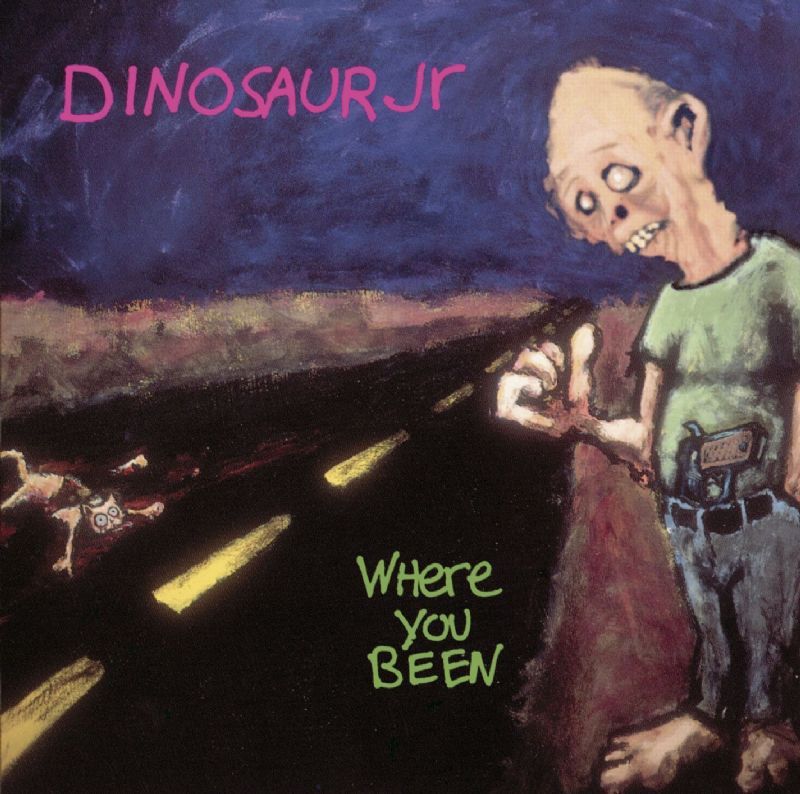
Dinosaur Jr. - Where You Been


            As a musician and a lover of music, it is truly a rare occurrence that any piece of music rubs me the wrong way. Whether I disagree with the sound or have a distaste for the writing, I almost always find some redeeming quality that brings me back. Thus, when I added Dinosaur Jr.’s Where You Been to my rotation, I opened my ears with all the objectivity that I feel is due every piece of music.
            I picked up this record purely on a whim and the faint impression that the opening track was a pretty good tune the last time I heard it. I knew very little about the band or the record, simply that it was part of the wave of alternative rock in the 90’s, which holds a very warm place in my heart. Thus, I felt that I was already predisposed to connect well with it. And I was very, very wrong.
            Initially, what is presented by Dinosaur Jr. is a good mix and lots of energy. They have a heavy and distorted sound, and all seem to wail on their instruments. Being that Where You Been is one of the few albums featuring the entire band’s participation in recording[1], the unity seems to have had a positive effect on the sound of the record. The musicianship is tight, and dotted with inspired fills, especially in Murph’s drumming. However, as one listens on, that tightness in the music is overshadowed by the obvious and overwhelming feebleness of the writing.
            The foremost weakness in the writing is the absolute lack of life or significance in the lyrics. Almost none of the songs have any coherent direction able to be communicated by the words. The lyrics seem a haphazard pile of phrases cluttered to fit a basic A-B-A-B rhyme scheme, purely filling the space of the vocal melody rather than attempting to connect with the listener. Furthermore, even the wording lacks inventiveness or interest. The opening lines of “Out There” communicate absolutely nothing: “I know your name/I know the people out there feel the same/I know you’re gone/I hope you got some friends to come along.”[2] Such irrelevance is portrayed by virtually every lyric on the record.

            This lack of enthusiasm for writing also seems to have seeped into the music, albeit on a smaller level. Many of the songs feature very basic and repetitive structure. While this normally wouldn’t matter, it becomes very obvious how much repetition is being used when every song is longer than four minutes. Each song begins to feel like two or three riffs being repeated into eternity, leaving the listener wondering if the CD is skipping. The only break to this monotony would be J Mascis’ guitar solos, which are powerful and yet also obscenely long, and so makes any attempt at improvisation seem muted.
            While the writing of the record is blatantly bad, it is a secondary concern when confronted with the vocal stylings of J Mascis. J’s guitar playing on the record is quite phenomenal, and it is obvious that he has earned his place behind the ax. However, he has absolutely no business behind the microphone. His singing style is one that features little to no vocal power, which truly drags the apparent energy of the musicianship down to the ground. His drawl, while certainly a signature, is sung at barely more than a whisper in many of the songs, drowning the lyrics in a crackling and whiny pond of voice. So weak are the vocals that J seems unable to even keep his voice in key most of the time. Furthermore, he also spends an inappropriate amount of time singing in a ridiculous falsetto—for instance, the entirety of “Not the Same”—which adds nothing but confusion to an already embarrassing listen.
            Despite being a house with a foundation built in quicksand, Where You Been does offer a few good tunes. “On the Way,” one of the few shorter songs on the record, features a fast and thrashing energy bordering on punk, as well as a more effective use of repetition in the structure. Topped with a catchy chorus and inventive fills on all instruments, it is a song that is more than listenable, indeed even recommendable. Another such song is “Start Choppin,” which reached #3 on the Modern Rock Tracks chart in the U.S. upon its release.[3] This song features some inventive arrangement along with rocking guitar riffs, providing a groove that the other songs apparently lack. Indeed, its endearing melody and feel even invite dancing, showing that apparently Dinosaur Jr. is capable of some good.

           Although a few gems are hidden on the record, as a whole, Where You Been holds very little merit as a collection of music. Between the flabby writing and the frail vocals, this record leaves much to be desired, and does not lend itself to multiple listens, nor a growth of interest in the artist. As this record approaches the twentieth anniversary of its release, it stands as a testament only to the detrimental effects poor writing can have on otherwise interesting musical pieces.

Saturday, January 19, 2013

Song Spotlight: "Here and Now" by the Ernies


            I’ve never been much of a gamer, but one of the first I ever played was Tony Hawk’s Pro Skater, whose incredible soundtrack truly began my love affair with music. That game was pivotal in giving me my first exposure to the genres of ska and punk, which have been pivotal in formulating my style of bass-playing. This game, besides being a ton of fun, invited me into a world inhabited by fast guitar riffs, pounding drums, and lilting horn melodies, all of which I would soon come to adore.
            THPS was my maiden voyage into music, and through it, I met the energetic honesty of the Suicide Machines, the sardonic and sarcastic stylings of the Dead Kennedys, and the thrashing fervor of Suicidal Tendencies. Perhaps most importantly, this game provoked my since undying love for Goldfinger, my favorite artist. Recently, I decided to delve back into that well of youth, and found myself re-exploring the tracks of this iconic soundtrack. During this process, I encountered one song that in years passed I had somewhat overlooked, but now, I find myself entranced by: “Here and Now” by the Ernies.

            This song rocks from the moment it opens with an immediately-in-your-face guitar riff. Turntables build to the drop of the beat, by which time the listener is grooving in his seat. That groove only intensifies as the song reaches the verse and the intense vocals take control. Will Hummel practically raps through his sturdy melody, pulling the listener into the simple yet elegant chorus that is full of soul. However, perhaps the most interesting moment is the bridge, which features a sudden and unexpected visit from a horn section as it blasts through a melody perfectly complementing the still-grooving guitar riffs and steady drumbeats.
            The brilliance of this song was never apparent to me before the whim to revisit my youth overtook me. Indeed, I remember only that I liked it as a kid, but never truly loved it. Yet now, I find it to be one of those songs that I cannot stop listening to, especially due to the fact that the horn section in this song was something that I never noticed as a child. Now, as a fan of ska and everything entailed in that sound, I was pleasantly surprised to hear those saxophones take control of what I thought was a straight alternative rock song. I was further surprised and delighted to later uncover that the Ernies always presented a ska-punk element in their music—indeed, their second record, Dropping Science, features a cover of the Operation Ivy staple “Sound System.”[1] However, they never let the label of “ska” dominate them, instead branching into all styles so as to present a unique and interesting sound[2], one that is especially apparent in this track.
            “Here and Now” by the Ernies had been a familiar acquaintance in my youth, and as I return to it, a little more seasoned, I find myself able to reconnect with it as I would an old friend. It echoes memories of my childhood while creating new connections with me as an adult, inviting me to continue exploring and enjoying the Ernies’ catalog. Such strength in a song shows that it will stand tall even as the years continue to pile upon us both.

Death From Above 1979 - Heads Up!


            Death From Above 1979 is a band that takes the bare minimum and turns out extraordinarily interesting and remarkable creations, and Heads Up! is no disappointment. From two men and their instruments comes an incredible and unique sound, frenzied and relevant. Their songs and style are not complex, composed mostly of thrashing bass riffs, pummeling drums, and heady melodies, yet in their expression and delivery, the six songs that compose this EP come to mean everything.
            DFA’s unique sound and style are epitomized in this EP. The fact that they have removed such a standard instrument as the guitar out of their mix, and yet are still able to maintain and consistently kill an energetic punk sound is simply incredible. Jesse Keeler creates rhythm and melody simultaneously with his bass, fully invalidating any arguments that their low-end-driven sound is missing something. Indeed, the little guitar moments wedged between songs on Heads Up! Seem almost to be pittances, mocking little scraps thrown to the standard rock sound.
            Every second of the fifteen minutes of music on this EP is brimming with energy and exuberance. Jesse and Sebastien seem to have compressed their entire metabolisms into this record, leaving nothing unsaid or unfelt by the listener. Each song is fast, catchy, and danceable, and yet chaotic in the distorted and crashing clamor that defines this band’s trademark. The vigor inherent in the music of this EP is so strong and apparent that one might mistake this for a collection of live recordings. Indeed, the parenthetical at the tail end of the title of the third track, “Do It! (Live),” seems misleading, since it sounds just as “live” as the rest of the record. The ferocity and honesty of these recordings is incredibly truthful in its energy, making Heads Up! a debut that completely captures and expresses the truth of Death From Above 1979.

            Both musically and lyrically, this record is relatively simple—yet such simplicity goes a long way. The music is straightforward in its presentation because it is straightforward in its purpose: it makes the listener dance. Sebastien’s drum beats create a pounding rhythm that constantly invites participation from the listener. In fact, many of the songs feature the sound of someone clapping along with the rhythm, which is no doubt what happens when DFA 1979 plays these songs live. This minimalism is further personified with great effect in the lyrics, which are more often than not straightforward statements or questions. In “Dead Womb,” Sebastien very blatantly rails against the party-girl image so many women portray with the words “We’re looking for wives/So tired of sluts/Coming to us in the clubs with their cocaine.”[1] In “Losing Friends,” words are not wasted as the same accusation is spoken against men: “You’re not grown men/You’re just kids playing.”[2] The lyrics of this record are presented without pomp or fanfare, acting as austere statements of truth. Fused with Sebastien’s passionate and catchy vocal melodies, these poignant and honest lyrics become anthem-like.

            Although the writing exhibited on Heads Up! is rather unadorned, it never leaves the listener bored or restless. Death From Above provides a very unique sound on their EP, and this individuality is reflected in the structure of their songs. For the most part, DFA 1979 avoids the standard “verse-chorus-verse-chorus-bridge/solo-verse-chorus” formula in the six songs that make up this record. While the songs do generally repeated sections, their arrangement in each song is different, avoiding the standard structure of most songs and therefore affirming that Heads Up! is anything but standard.
            The innate and unabashed honesty of this EP is something that really drew me into it, and that beckons me to return to it so often. Every song churns so wildly and artistically that it can’t be anything but a true expression of the artist that is Death From Above 1979. The band is very aware of their identity and what they want from their music, and in fifteen minutes they give the listener nothing but a pure draught of themselves. In the words of Jesse, “We’re just making music and you happen to like it.”[3] This truthfulness of expression that the music on Heads Up! undoubtedly bleeds only sharpens this already intense listening experience.
            As it stands, this EP leaves a monster impression upon the listener without even trying, a statement from a band rejecting fanfare or flamboyance in order to do exactly what it wants. Death From Above 1979 smashes their instruments to pieces in every song, not to astonish or impress, but simply because it is what they do. The music is easily appreciated by both body and mind, being danceable and listenable without exception. With Heads Up!, Death From Above 1979 picks you up off your feet and launches you into the heights. How you make it back down is up to you.

Tunes to Check Out:
1) Dead Womb
2) Do It! (Live)
3) Too Much Love

Monday, January 7, 2013

Smashing Pumpkins - Oceania


Oceania is a record that in many ways redefines the idea of Smashing Pumpkins. Like the protagonist Winston Smith of the novel 1984 (which the title of the record alludes to), whose job is to edit historical texts as the government sees fit, Oceania takes what the world previously expected of the act known as Smashing Pumpkins and rewrites it in a more contemporary light.
This record is one that invites mixed feelings from me, especially considering my die-hard fandom of this band. Oceania provides where it needs to the crunching rock tunes, while also exposing a vulnerability not usually felt in a band headed by an established musical creator such as Billy Corgan. It is full of songs both powerful and gentle, but the distribution of those songs does more to hinder the energy of the record as a whole than to accent it. There seems a constant catch-and-release of the vigor inherent in the music, making it a record that’s a little hard to get into. Yet, sincerity and strength are constantly delivered, always with an original flavor.
While I would normally try and avoid making comparisons between a record and the artist’s other work, I think it important to note that Oceania truly sounds like nothing else the Smashing Pumpkins have done before. While songs like “Quasar” and “Inkless” do have a feel reminiscent of Siamese Dream, the fact that this record is not only full of extensive keyboard parts, but in fact relies on them, lends it a texture of originality. In an interview with NME, Billy Corgan remarks that Oceania “is the first time where you actually hear me escape the old band. I’m not reacting against it or for it or in the shadow of it.”[1] This escape is clearly evident in both the composition and the sound of the record. The bleepy-bloopy synths in songs like “Pinwheels” and “One Diamond, One Heart” are absolutely necessary in that they create the crux of the song to which the other instruments react. Such keyboard-centric writing in a band that does not have a resident keys player denotes a fresh take on a band that has again become fresh both in personnel and creativity.
This originality is most powerfully expressed in the song “Glissandra,” my favorite off of Oceania. This song is full of both movement and emotion from its first note, as both vocals and instruments exude a melancholy aura that is easily relatable. The writing and instrumentation of “Glissandra” capture the essential image of Smashing Pumpkins, yet it retains and even announces its youth and innovation by providing syncopated riffs and a subdued spotlight on the synth, the signature of the sound that this record is expressing. Lyrically, it is one of the most poetic pieces, filled with turns of phrase and capped with the catchy hook of “I used to know.” Putting all intricacies dripping from this song aside, it simply grooves like no other tune on the record.

While the synth-heavy sound of the record certainly provides a unique feel, it also seems to have affected the writing in a negative fashion. The keys may fill out the song musically, but they leave much to be desired creatively. When the keyboards are center stage, the guitar is buried, if it is to be heard at all. Furthermore, “One Diamond, One Heart” and “Wildflower,” two songs that showcase the synth as the main instrument, I find almost unbearable to listen to, because they rely so heavily on one instrument that the others are virtually if not completely deleted. The synths seem cute at first, but ultimately, at least in the case of these two songs, leave the listener utterly bored.
Unfortunately, this apparent albeit infrequent weakness in the writing is not contained to just the instrumentation. The vocal melodies on the record are inconsistent in the ways they shine. For the most part, Billy’s vocals are soulful and truthful, and his lyrics dance fluidly, wanting not for depth in meaning or musicality. Songs like “The Chimera” feature Billy singing in an energetic and impassioned fashion, truly filling out the song. Yet, in other places, Billy’s melodies, along with the lyrics shaped upon them, seem frail or forced. The lyrics of “The Celestials,” the first single off of Oceania, seem as passionate and meaningful as the list of ingredients on a shampoo bottle.
Although such complaints can sometimes hold a record back, ultimately they take nothing away from the integrity of the music. Both Billy Corgan and Jeff Schroeder tear apart their guitars in wailing riffs adorning the solid yet beautifully ornamented foundation of Nicole Fiorentino’s basslines. Yet the drums seem to steal the show, with Mike Byrne’s youthful and spastic percussion sounding always like his kit is about to be broken by the sheer force of his drumming. Indeed, Byrne’s pounding percussion in “Panopticon” was singled out by Spin Magazine[2] in its review of the album. Truly, any holes in the hull of Oceania are easily patched with the chemistry of soulful musicianship displayed by this quartet.

Ultimately, Oceania is a record that was destined to be judged from its conception. Yet it enters the room, arms spread wide, fearless and honest in its presentation. It has songs I will skip over, but also songs that I crave to hear again and again, all of which stand as testament to the humanity of this new take on an old name.

Tunes to Check Out:
1) Glissandra
2) The Chimera
3) Quasar 

The Contortionist - Exoplanet


            To someone who is not a musician, this record has a good chance of sounding like a mouthful of soulless terror. From beginning to end, the listener’s ears are stuffed with guttural screams, heavily distorted guitars, and rhythms that are almost impossible to dance to. However, such intensity is something that any worthwhile band (especially one delving into genres such as mathcore or death metal) must provide, and with Exoplanet, The Contortionist certainly delivers.
            Listening to Exoplanet is similar to listening to the rants of a mad scientist. The record is equal parts creativity and obsession, yet that creativity reflects both beauty and insanity, the obsession both harmony and cold savagery. For the most part, the sound can only be described as brutal, as the band shreds and chugs its way through low-tuned atrocities without relent. But counteracting this darkness is a catalog of fusion-jazz guitar riffs, clean vocal melodies, and beautifully structured sections of song, reflecting the wide range of musical influences cited by the band, a list including Porcupine Tree and Between the Buried & Me[i]. Such interposition of heavy and light allow for the songs to be very engaging without sacrificing any of the hard edges demanded by the style.
            One such example can be seen in the second song on the album. “Flourish” opens with exactly that, sweeping guitars and a 9/8 time-signature, before descending into an increasingly intense section of music. The song convinces you that it is another back-breakingly heavy artifice of pure metal, and then breaks off into an incredibly melodic and gentle bridge section. The music moves from cold to compassionate, carrying the listener on a lilting guitar melody, before inviting them back into the pit with a rephrasing of the song’s opening riffs. The seamless alternation of dynamics and energies in “Flourish” showcases this band’s ability to deftly switch between musical styles, making for a composition that is both aesthetically and intellectually pleasing.

            Exoplanet appears to be a thematic record, a chronicle divulged through music. This idea is expressed both lyrically and musically. Melodies and chord progressions are presented and then revisited repeatedly throughout the record. This is done no more beautifully than in the songs “Contact” and “Axiom.” In “Contact,” we are presented with an endearing moment of music in which soaring guitars playing in a 5/4 time signature are placed flush against a 4/4 drum beat. This same riff is then re-imagined through acoustic guitars and piano in “Axiom,” the pounding drums replaced by a tambourine, expressing a malleability of music that many artists find hard to explore.

            Musically, this record is as detailed as a Renaissance sculpture. Every single note seems to have been meticulously placed in flawless (although often dissonant) harmony with every other note, and the sheer amount of time-signature changes alone suggests that this band has put an immense amount of time into authoring their music. The Contortionist leaves absolutely no room for error in any of their compositions, showing that they are a band whose intention and execution are perfectly on par, and giving the listener a truly deep musical experience. However, it is also important to note that such musical technicality is a factor much more easily appreciated by musicians than non-musicians—the intensity of structure and atonality in songs like “Advent” and “Exoplanet II: Void” can just as much serve to alienate listeners as to draw them in.
            While this record is full of true and unique musical experiences, it also regrettably ends up encountering some the predictable pitfalls inherent in the genre. The level of technicality and precision in the writing on the record is of such magnitude that it can seem robotic: all intellect and no soul, and so fabricated that there is no room for the band’s humanity to shine through. Furthermore, much of the beauty of the writing is buried by the demands of the genre. For instance, the lyrics of the record are as well-crafted as the music, a narrative communicated through poetry, infused with existential and exotic themes ( “Contact” acts as a transcript of transmissions between two parties[ii]). However, because the style of music compels the screaming of most of these lyrics, invariably these words and all their meaning are completely overlooked. Such heavy vocals, while making a superb match to the brutal energy of the instrumentation, delete the emotion that might otherwise be imparted by intelligible lyrics or a sung melody.
            Ultimately, Exoplanet is a record built of relentless and exhaustive effort, and no one can say that The Contortionist has given anything less. It is an example of a group knowing exactly how it wants to sound, and relentlessly pursuing that idea. It bleeds power and cunning, standing as a monument to controlled chaos. The members of The Contortionist presents us with the simple and brutal truth of themselves, and if you can dig that, you risk nothing in giving them a listen.

Tunes to Check Out:
1) Flourish
2) Exoplanet I: Light
3) Contact