Sunday, August 16, 2015

The Vandals - Hitler Bad, Vandals Good


            It's so easy for me to fall into a pretentious mindset when discussing music, but when I'm being honest, there are few things I enjoy more than a goofy tune that refuses to be taken seriously. While many artists will occasionally shrug off the serious looks long enough to record a silly song or two, very few are as bold as The Vandals, a punk act that continuously composes entire records of humorous music.
            Since I first heard them in my teen years, their lack of gravity provided a wonderful alternative to the hundreds of stuffy and semi-political punk anthems of their peers, and the fact that their songs were popping up in all my favorite video games at the time only drew me in further. When I finally had a chance to pick up Hitler Bad, Vandals Good at age fifteen, I immediately connected with the humor and hectic energy, and though I’m certainly older and allegedly more serious, the lighthearted hilarity still hits just as hard.
            Unlike most records, the very first part of Hitler Bad, Vandals Good that grips my attention is not the musicianship, but rather the record’s inane lyrical content. All four band members share writing duties,[1] yet not one among them seems to take writing seriously, which is a ridiculously refreshing change. While there is an almost universal theme of romantic (and often unrequited) love through the record, each relationship is cast in a unique situation: “Fucked Up Girl” expresses love for a “legally insane” woman who is “losing all [her] faculties,”[2] while “I Know, Huh?” analyzes the awkward intricacies of being in an interracial couple. And while their ideas aren’t always that original (they’ve openly stated how big of an inspiration TV is in their writing)[3], such silliness is guaranteed to bring a smile to even the most grumpy listener’s face.


            The Vandals’ humor on Hitler Bad, Vandals Good strays into darker territory as well. “Too Much Drama,” co-written by The Offspring’s Dexter Holland,[4] humorously tackles the topic of absent parents, while “People That Are Going to Hell” very casually references scumbags who “beat their wives / or pull out a knife and stab a person or two or three.”[5] Even love takes a dark turn in “My Girlfriend’s Dead,” a song characterized by a broken-hearted man who avoids discussing how he was dumped, instead “tell[ing] them all she’s dead” because he “likes the sympathy” it garners.[6] Without shying from the inherent depravity of their material, The Vandals manage to spin even the darkest parts of humanity into carefree song.
            Hitler Bad, Vandals Good is a laugh from start to finish, but for me, no song is more ridiculous than “I’ve Got An Ape Drape,” the band’s infamous ode to an awful haircut. With a frenzied chord progression that hugs the melody and a gang-vocal chorus, this tune celebrates all that is wrong about the mullet. With almost childlike innocence, Dave Quackenbash demands that his hairdresser “make it short in front and long in back” like “that dude I saw last night on Jerry Springer,” before ultimately requesting that his son get the same horrid haircut, a decision that apparently qualifies as “bonding with your dad.” The song even includes an off-hand reference to Billy Ray Cyrus, whom the band holds responsible for perpetuating what they have coined “Achey Breaky Hair.”[7] With its repetitive chorus and triumphant satire, “I’ve Got An Ape-Drape” presents a sidesplitting homage to a horrible idea that is far from disappearing, and worst of all, “they’re giving them to anyone, and that means you!”[8]


            In sharp contrast to the amusing and off-hand lyrics, the musicianship on Hitler Bad, Vandals Good is both tightly-knit and complex, perhaps because the band felt that room to “musically…stretch out a bit” on this record.[9] Drummer Josh Freese rips through slash-beats in virtually every song, yet somehow manages to squeeze effortless fills and rolls among his madness. In a similar vein, bassist Joe Escalante and guitar wizard Warren Fitzgerald compose effortless and interwoven rhythmic parts which maintain intricacy even at 190 bpm. Add on top of that impeccable Beatles-esque harmonies and a punked-up cover of “So Long, Farewell” from the Sound of Music, and The Vandals have handed us a pile of lightning-fast tunes that guarantee laughter as much as they do moshing.


            Because punk rock has a more rigid sound structure (super fast and super loud) than other genres, all too often a punk record will be composed of songs so similar in tempo and energy that they simply bleed together. While Hitler Bad, Vandals Good is no exception, featuring more than a few songs loaded with power chords and cliché progressions, The Vandals do make some valiant strides towards breaking up any monotony. The band layers various instruments into their songs, such as a bongos in "If the Gov't Could Read My Mind" and a tuba in "I Know, Huh?" But rather than just squeeze those new instruments in, The Vandals choose to arrange their own parts to complement the new textures, thus justifying the added horn section in "Fucked Up Girl" by moving into a full-out blues.
            Some songs off of the record even go so far as to acknowledge the limitations of the genre of punk. Both "I've Got an Ape Drape" and "Money's Not an Issue" repeat certain riffs or sections ad nauseum; this deliberate application of the extreme simplicity that a lot of punk acts embrace proves The Vandals to be a very self-aware act. And just as often as they embody their punk ethics, so too do they shun them: "Euro-Barge"  features a fantastically un-punk time signature change, alternating between measures of 7/16 and 4/4, while "People That Are Going to Hell" relies on a very strange melody built to defy the downbeat. Hitler Bad, Vandals Good might be a punk record, but The Vandals work hard to bring more to the table than slash-beats and simple shouting. 


            Although neither the most exciting or enlightening record, Hitler Bad, Vandals Good is still and excellent example of how music can resonate without being stuffy. The Vandals know exactly who they are and what they want from this endeavor: to play fast punk and to make people laugh. There is not a drop of doubt or indecision at any point on this record, and such honest identity makes for a pretty fantastic listening experience. Even a decade after I first heard them, many of the songs on Hitler Bad, Vandals Good keep me cracking up, and remind me that a serious song can be just as heartfelt as a nonsensical one.  

Tunes to Check Out:
2) I've Got an Ape Drape
3) So Long, Farewell


Friday, July 24, 2015

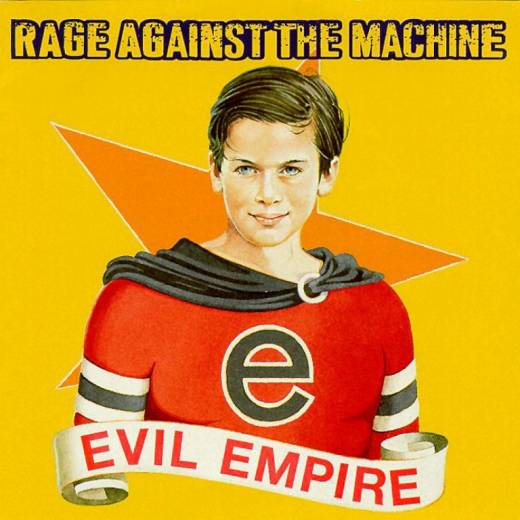
Rage Against the Machine - Evil Empire


            By the time my love affair with the bass began to burgeon, I was already a hardcore fan of the hip-hop/metal hybrid that was Rage Against the Machine. My first two years of learning the bass involved incessant spinning of all records Rage, working my fingers into and through callus after callus to emulate Tim Commerford. Even now, there is nary a day where I pick up my bass without finding my way along one of Rage Against the Machine's aggressive riffs, evoking memories all the teenaged angst and hormonal heaviness that coursed through me as I struggled to learn those basslines. In a fit of desperate (but not unwelcome) nostalgia, I threw into rotation my favorite RATM album, Evil Empire, and quickly found that it has not just held up to thirteen-year-old Ryan's assessment, but far surpassed it.  
            Although written in a relatively short (and allegedly tumultuous) period of time,[1] the sound of Evil Empire feels far more calculated than most records. Rage Against the Machine has always been in a genre of their own, simultaneously encompassing the sonic territories of metal, punk, and hip-hop and simply killing it. Serious attention has been given to the aesthetic of every riff and line: Tom Morello's scratchy chords and grating turntable-esque solo in "Bulls on Parade" encapsulate the feel of underground hip-hop, while the band's heavy riffing on the choruses of "Roll Right" and "Snakecharmer," coupled with Zack de la Rocha's almost antagonistic screams, feel pulled right off the stage of a hardcore punk show. Every second of this record shows all four members of RATM operating as a seamless unit, acting and reacting as one as they shatter every genre boundary they approach.  


            Rage’s accomplished and deft musicianship is certainly showcased in its composition, but the true focus of Evil Empire is the intensity of the band's performance. Zack de la Rocha's vocals flare forth from his body like fireworks; his voice is vehement and wracked with emotion, perfectly capturing the ire of his words as he screams lines like the refrain of "Revolver:" "Don't mothers make good fathers?”[2] Similarly, Tom Morello's guitar work, while inevitably straying into the insanity of effects that is his signature, is more often focused through explosive chords and riotous riffing that go off like grenades, such as in the outro of "Wind Below." His attention to guitar tone allows him to simulate a faultless synthesizer in "Down Rodeo" as easily as he rips through a metallic 5/4 riff in "Year of tha Boomerang," slipping into hip-hop here and there and filling the rest with undiluted rock.  
            De la Rocha and Morello bring the texturing and tension to Evil Empire, but for me, it is the indomitable rhythm section of Tim Commerford and Brad Wilk that really move the music. Commerford slams the notes out of his bass strings, his low tone snarling with overdrive and wrapping themselves around Wilk's solid hits and frantic fills. The intensity inherent in "Snakecharmer" and "Vietnow" is reinforced by this duo's effortless synchronicity, while the slash-beats and rhythmic changes on the drums in "Tire Me," coupled with Commerford's ferocious bass, shove the spotlight directly onto the sidemen. Although Wilk and Commerford can just as easily groove in the hip-hop vein as their treble counterparts, it is from the rhythm section that the rock really pours forth.  


            With such dynamic and groundbreaking instrumentation as this record sports, only writing of a higher caliber could complete a picture as detailed as Evil Empire, and Zack de la Rocha does not disappoint. Zack blends poetry and politics into his penetrating vocal style, controlling his emotion with whispers, exuding it in his singing, and hurling it towards the listener in irate shouts and screams. Every word drips with fury, and while managing that alone is admirable, the meanings behind the words are even more focused, more vital, than their delivery.
            Far from squandering his talent with the pen, de la Rocha admirably lends his voice to issues far bigger than the usual musician. Being that Rage Against the Machine has always been a political outfit with a “mission to expose their community and generation to real issues,”[3] Zack entirely avoids personal topics in his lyrics, instead sharpening his writing into a sword for fighting injustice and ignorance. Rather than painting obscure scenes or vague atmosphere, his words dive into the darkness of the world and force it to rear its hideous head; in lines like “the gut eaters, blood drenched,”[4] Zack’s images embrace the horror and force the listener to know it as a reality. Furthermore, he then calls his listeners to action with the insistent “now it’s upon you” in “Year of tha Boomerang”[5] or the urgent “don’t freeze when zero hour come” in “Roll Right,”[6] reminding us that each and every person is affected by these matters.  
            While de la Rocha addresses a wide variety of important topics including gang violence and racism, the writing on Evil Empire is primarily focused on the theme of the Zapatista movement, an issue close to Zack’s heart and one in which he has been personally involved.[7] Songs like “People of theSun” portrays the oppression of the Zapatistas,[8] comparing their struggle to that of the Aztec empire under the rule of the invading Spaniards, while “Vietnow” attacks right-wing U.S. media for its lack of fair coverage on the issue.[9]


            In a 1998 interview, Zack stated that “through… our song's lyrics we have placed within reach of young people, our audience, the experiences of the Zapatistas.”[10] Zack’s proximity to the movement bleeds from both his words and his voice, asserting his honest connection with the Zapatistas’ struggle and his true desire to see justice served. And though lines like “while the gut eaters strain to pull the mud from their mouths / they force our ears to go deaf to the screams in the south”[11] may drip of metaphor, he ensures that not a drop of sincerity is lost in translation from problem to poetry, because his writing and music have one simple purpose: to “give space and volume to various struggles throughout the country and the world.”[12]
            After blasting Evil Empire in my car for weeks, I am hardly surprised at how well it has held up, both for my memory and my musical tastes. Rage Against the Machine throws all their anger and intensity through the speakers, a signature sound that, for all its idiosyncrasies, just does not grow stale. And while thirteen-year-old Ryan could hardly wrap his head around the political layers of lyrics, my (relative) maturation and increased awareness of some of the issues presented on Evil Empire allows for a deeper connection to the songs, specifically to the honesty inherent in RATM’s message. All in all, Evil Empire is a record that has only become more powerful since I first heard it, and that fact alone is far more refreshing than any bid of nostalgia. 


Tunes to Check Out:
1) Tire Me
2) Bulls on Parade
3) Snakecharmer


Sunday, June 28, 2015

The Dillinger Escape Plan - One of Us is the Killer


            Few acts are as synonymous with the idea of insanity as The Dillinger Escape Plan. I remember hearing a story in high school from an acquaintance that had just seen them live, claiming that lead singer Greg Puciato had literally run across the room on the heads of the crowd, and as more and more of my friends became fans of them, further wild accounts of this band’s prowess and madness made it into my ears. Despite being a big fan of other technical acts such as Norma Jean and Between the Buried & Me, I had never found my way into any of Dillinger’s music, until my friend and drummer for Hiss the Villain (who all but worships Bill Rymer) insisted I check out their newest release, One of Us Is the Killer, which quickly proved to me just how insane this act can be.
            Despite being credited with creating the genre of mathcore,[1] a style over which they certainly hold mastery, The Dillinger Escape Plan is far more diverse in their sound than that label suggests. While writing One of Us is the Killer, the band's intention was to "consciously...push ourselves into uncomfortable territory rhythmically,"[2] and with that in mind, they manage to intermingle jazz and salsa rhythms with the speed picking and chugs that define the mathcore feel, giving a refreshing take on a sound that has already been beaten to death. Drummer Bill Rymer easily earns his accolades, loading syncopated hits and polyrhythms into every song, creating both percussive pipebombs and tiny ear-catching firecrackers. Similarly, guitarist and primary composer Ben Weinman moves so quickly up and down his neck that his hands must be bleeding. He layers intricate lines and full chords to fill out the treble zone, while Liam Wilson dominates the low-end with his roaring bass, absolutely ripping up the intro to "Crossburner" with his distorted tones. And if the heaviness isn’t enough, The Dillinger Escape Plan even has the audacity to add a horn section and soundscapes to their varied metal, further diversifying their brand of chaos.


            By far, Dillinger’s sound on this record is loaded with intensity and technicality, but as is too often the norm, the extreme competence of the musicians sometimes causes the music to stray into the territory of noise. Although a lot of their polyrhythms are aesthetically pleasing, portions of songs like “Hero of the Soviet Union” and “When I Lost MyBet” are so rapid-fire and syncopated that the CD might as well be skipping. Similarly, the riff that makes up the entirety of “CH 375 268 277 ARS” is interesting, but so repetitive and unresolved in any way that it alienates the listener more than it draws him in. Although I respect every risk that The Dillinger Escape Plan takes on One of Us is the Killer (even the abuse of odd accent cymbals as well as a xylophone), I’d be lying if I said there aren’t a few moments where I am totally lost by their thought-driven composition. 
            Despite some of the more soulless sections of song, The Dillinger Escape Plan gets it right way more often than wrong, and the best example of these four completely dominating is in the title track, “One of Us is the Killer.” Sliding into existence with an almost-inaudible arrangement, Puciato sings in a high falsetto, winding his melody between Rymer's whispering cymbals until the chorus goes off like a nailbomb. Although Dillinger adds their standard flair with polyrhythmic hits in the chorus and an atonal 21/8(!!!) bridge, the overall structure of the song is simple and palatable, causing their insanely technical choices accent the tune rather than drive it. Furthermore, they create an emotional space that allows Puciato to simply go off, his vocals running the gamut of sound from gentle high notes to throaty screams and beyond as he contemplates the binary nature of unhealthy relationships.[3] With "One of Us is the Killer," The Dillinger Escape Plan finds the perfect balance in loud/soft dynamics and simple/complex riffing, using moderation in all senses to produce an excellent and intricate tune.


            From the opening salvo of the album, it is quite obvious just how good the musicians in The Dillinger Escape Plan are, but in my opinion, no member is more interesting in his contributions than Greg Puciato. There is a sheer, honest intensity that bleeds from his voice in every take, a true connection between emotion and diction. His vocal performances stem from true outbursts of feeling, which are sometimes so strong or violent that the very microphone he is recording with gets mangled in the process.[4] This experience of truly exploding during vocal takes is one that Puciato describes as "fucking therapeutic,"[5] as it allows him to come to terms with the subject matter of his songs. In an interview with Chad Bowar, Puciato remarks that "if you're in the studio screaming about something, you should relate to it,"[6] and indeed, Greg embodies the visceral reactions inherent in his emotions, channeling them through his voice to make the vocals on One of Us is the Killer so real, he might as well be screaming in your backseat.
            As with the sound of his vocals, Greg Puciato's process for writing the lyrics those sounds will encapsulate is just as driven and inspired. Unlike most vocalists, Puciato waits until right before recording to pen the lyrics, sketching "blurts" and "blobs" until he realizes the direction the song must take. As he puts it, "the reason you create art is to get something out of you or learn something about yourself that helps you move past something or grow in some way," and by writing the lyrics to the entire record in a short amount of time, he is able to maintain a "consistency and honesty" in capturing a certain moment of his life.[7]
            Of course, this hyperfocus placed on creation of the lyrics over a short time span leaves little room for intricacy to enter the writing. While some of Greg's ideas slip into poetics, such as the lines "Drag the knife across the skin / tempted to succumb / carving fervor into flesh / holy we've become" in "Understanding Decay,"[8] the rush in which most of the writing happens leaves clichés littered throughout and much of the rest as blatant statements. Indeed, the words to the chorus of "Nothing's Funny" are so simple they come off as absolute drivel: "Eventually the jokes aren't free and nothing's ever fun and nothing's funny."[9] However, knowing that Greg's writing process is focused on capturing the true emotion in the words and presenting it brutally and uncut, the relative unimagination of the lyrics is completely forgivable. Furthermore, as hackneyed as the phrase "you are the scum of the earth" may be, I simply cannot tire of hearing Greg rip those words from the bottom of his lungs.[10]


            As Ben Weinman aptly puts it, "There is no specific Dillinger way - there's no right or wrong way of doing things. [We] just make it work."[11] On One of Us is the Killer, The Dillinger Escape Plan pushes the envelope in countless ways, but more importantly, pushes themselves into spaces they've never explored themselves. Regardless of any shortcomings, this band worked their asses off in making One of Us is the Killer into a unique experience, which alone is something amazing to see and even more amazing to hear. After spinning this record until it started skipping and then some, I can truly say that I've never heard anything like The Dillinger Escape Plan, but I'm very grateful that I did. It is a record fuming with anger and energy and enthusiasm, extremely intricate, extremely diversified, and yet extremely listenable, and I have no doubt I will be returning for more.


Tunes to Check Out:
1) One of Us is the Killer
2) Crossburner
3) Nothing's Funny